
News

Groundbreaking SAFe-nSCAN multi-scale imaging platform to revolutionize tissue analysis
With its game-changing technology, the nanoSCAN project will provide crucial 3D spatial biology imaging insights into cell and tissue function, improving the effectiveness of cancer immunotherapy by identifying the best therapy for a patient. The project will receive around...

360 CARLA: A New Horizon in Photonics Career Development
After the success of the CARLA project, the European consortium, coordinated by ICFO, has launched the 360 CARLA project, a comprehensive career development initiative aimed at shaping the future of photonics professionals. The 360 CARLA project signifies a collective...

Laserlab-Europe Newsletter #35: Scanning the Body
In the broad field of modern medical diagnostics and scientific research, the intricate landscapes of the human body unfold through the lens of cutting-edge biological imaging technologies. The following articles present some of the ways in which Laserlab-Europe’s researchers...

Position Paper published by Expert Group on ‘Micro- and nano-structured materials for experiments with high-power lasers’
The Laserlab-Europe Expert Group on 'Micro- and nano-structured materials for experiments with high-power lasers' has published its position paper. High-power lasers are used worldwide for a very wide range of applications. To cite a few of them, nanosecond terawatt-scale peak...

Laserlab-Europe congratulates Anne L’Huillier, Pierre Agostini and Ferenc Krausz on receiving the 2023 Physics Nobel Prize!
The Nobel Prize in Physics 2023 was awarded to Anne L’Huillier (LLC, Sweden), Pierre Agostini (Ohio State University, USA) and Ferenc Krausz (MPQ, Germany) for experimental methods that generate attosecond pulses of light for the study of electron dynamics in matter. The three...

ReMade@ARI – A recycling hub for materials research
The EU project ReMade@ARI starts on 1 September with participation of Laserlab-Europe AISBL. According to the European Union's Circular Economy Action Plan, the industry can determine up to 80 percent of a product's subsequent environmental impact at the design phase. However,...

European Laser Science and Technology Landscape Analysis Published
Laserlab-Europe and the Extreme Light Infrastructure (ELI ERIC) have joined forces to analyse the current laser-based science landscape in Europe. The analysis aims to assess the European laser community to provide a better understanding of the services offered to users by...

Laserlab-Europe Newsletter #34: 3D Biomedical Imaging
Biomedical imaging plays an important role in health and life sciences, with 3D biomedical imaging now opening new possibilities from basic research to clinical diagnostics and treatment. The articles in this focus showcase examples of possible applications and tools with a...

Laserlab-Europe AISBL elects John Collier as new Executive Director
The General Assembly of Laserlab-Europe AISBL, the international not-for-profit association representing 47 leading laser research infrastructures in 22 European countries, has elected John Collier, Director of the Central Laser Facility (CLF), an institution of the Science and...

Revolutionising medical imaging: fastMOT proposes light sensing solution for non-invasive imaging of deep organ structures
With its innovative fast gated, ultra-high quantum efficiency single-photon sensor, the fastMOT project will enable deep body imaging with diffuse optics. Implemented in the new Multifunctional Optical Tomograph, the light sensor will achieve a 100x improvement of...

Laser research community THRILLed — Ten million euro funding for high-repetition-rate laser technology developments
The THRILL (Technology for High-Repetition-rate Intense Laser Laboratories) project received more than ten million euro of funding in the framework of the European Union’s HORIZON EUROPE program. The project aims at providing new designs and high-performance components for...

Laserlab-Europe Newsletter #33: Lasers and the Universe
Laserlab-Europe – bringing together all the required instruments and related expertise – is a unique place to investigate our Universe. Lasers are indeed exceptional tools to explore phenomena occurring in space. Data from laser-based spectroscopy endstations can help...

Britta Redlich and John Collier elected Chair and Vice-Chair of General Assembly of Laserlab-Europe AISBL
Laserlab-Europe AISBL, the international not-for-profit association representing 45 leading laser research infrastructures in 22 European countries, is pleased to announce that Britta Redlich and John Collier have been elected Chair and Vice-Chair of the General Assembly....

Laserlab-Europe Newsletter #32: Lasers Shaping the Nanoworld
Lasers are perhaps the single best tools for interacting with nanometre-scale objects and physics. Offering great precision in terms of size, time and energy, lasers are facilitating ever-increasing control of both the physical shapes of specimens and the metaphorical landscape...

Laserlab-Europe AISBL elects Jens Biegert as new Executive Director and appoints new Board members
The General Assembly of Laserlab-Europe AISBL, the international not-for-profit association representing 45 leading laser research infrastructures in 22 European countries, elects Jens Biegert from ICFO - The Institute of Photonic Sciences in Barcelona, Spain, as new Executive...

Laserlab-Europe Newsletter #31: Lasers Exploring the Nanoworld
With the advancement of technology over the last half-century, a new frontier has opened up: the nanoscale. Nanometre-scale materials and technologies have the potential to be fast, efficient and effective in unprecedented ways, from metamaterials to specialist chips to...

Laserlab-Europe for a better future – Position Paper published
In a joint position paper, Laserlab-Europe highlights its integrated, cross-domain and multi-faceted approach to address the societal challenges of the Horizon Europe Missions. Lasers are crucial tools for the way we retrieve and transmit information, and how we analyse minute...

Laserlab-Europe Newsletter #30: Lasers and Clean Energy
Clean energy is a very broad field of research, ranging from fundamental science (such as charge recombination dynamics in artificial photosynthesis) and specific technologies (such as improving light accumulation on a solar panel or reducing particulate emissions in a...

Analytical Research Infrastructures as key resources for the five Horizon Europe Missions
Seven European networks have joined forces in the ANALYTICAL RESEARCH INFRASTRUCTURES IN EUROPE (ARIE) working group and released today a common paper, which highlights how their complementary approach will help address the societal challenges of the Horizon Europe Missions...
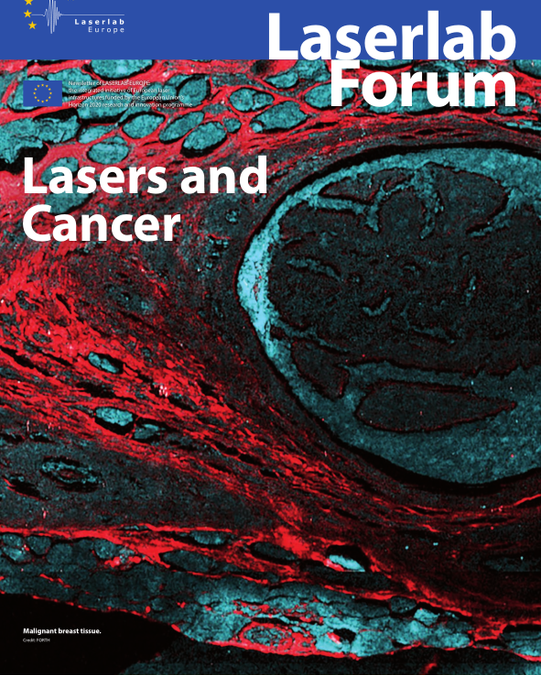
Laserlab-Europe Newsletter #29: Lasers and Cancer
Cancer affects people of all ages and walks of life, with 2.6 million diagnoses and 1.2 million deaths every year in the EU-27. The use of lasers for cancer treatment began in the 1980s, with laser ablation used on tumours. More recent work uses a far broader spectrum of laser...