
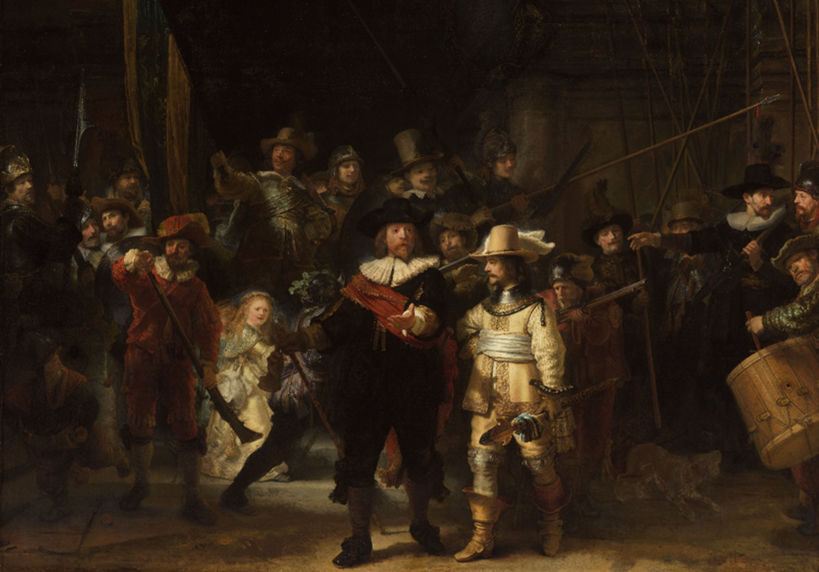
This study explores Rembrandt’s use of two rare arsenic sulfide pigments in The Night Watch. A combination of macro- and microscale analytical techniques were used to study the historical paint. Micro-Raman spectroscopy confirmed a mixture of yellow pararealgar (As₄S₄) and an orange-to-red semi-amorphous pararealgar – both previously unknown in Rembrandt’s oeuvre. Historical and art historical sources further contextualize their presence in 17th-century Amsterdam.
Rembrandt van Rijn’s The Night Watch (1642) is widely regarded as one of the Netherlands’ most significant masterpieces. In 2019, the Rijksmuseum launched Operation Night Watch, an extensive conservation and research initiative carried out within a glass enclosure in the museum’s galleries. The project seeks to answer three central questions: How was the painting originally made? What is the current condition of the painting? And how can it be best conserved for the future?
To pursue these aims, the team employed a broad range of analytical methods, beginning with non-invasive imaging such as macroscale X-ray fluorescence (MA-XRF) scanning. This technique provides elemental information from both surface and subsurface paint layers. The resulting elemental distribution maps revealed the use of arsenic sulfide pigments in the costume of Lieutenant Willem van Ruytenburch, a prominent figure positioned near the center of the composition (Figure 1). Rembrandt appears to have selected these pigments to achieve warm orange-to-gold tones that convincingly suggest gold-thread embroidery.
Because arsenic sulfide pigments rarely appear in Rembrandt’s palette, two microscopic paint samples were extracted for further investigation. These were analyzed using light microscopy, scanning electron microscopy with energy-dispersive X-ray spectroscopy, micro-Raman spectroscopy, and synchrotron-based micro-X-ray powder diffraction.
While pararealgar has often been interpreted solely as a degradation product, the evidence here suggests intentional use. The yellow and orange-red particles appear unaltered and are heterogeneously dispersed throughout the paint. Contemporary records indicate that heating pararealgar, as was also done for orpiment, could produce deeper orange-to-red hues, explaining the presence of semi-amorphous material. Moreover, historical records reveal a wider range of arsenic sulfide pigments available in 17th-century Amsterdam – both natural and synthetic – than the typically cited orpiment and realgar. The intentional use of such mixtures finds further support in a comparable combination identified in a still life by Willem Kalf, a contemporary Amsterdam painter (see Figure 2). These sources illustrate that 17th-century artists were knowledgeable about modifying arsenic sulfides to obtain specific color variations.

Figure 1
a) The Night Watch (1642) by Rembrandt van Rijn. b) Detail of Lieutenant Willem van Ruytenburch’s yellow costume. c) MA-XRF arsenic (K-line) distribution map corresponding to the white rectangle in b. d) Stereomicroscopy image showing the orange paint.

Figure 2
a) Dark-field (DF) light microscopy image of sample SK-C-5_017, showing Raman measurement points A–D. b) Dark-field (DF) light microscopy image of sample SK-A-199_R9/4, taken from Willem Kalf’s Still Life with a Silver Jug and a Porcelain Bowl, indicating Raman measurement points E–H. c) Raman spectra collected at points A–D of sample SK-C-5_017, shown alongside a reference pararealgar spectrum (RRUFF database ID: R150123). d) Raman spectra collected at points E–H of sample SK-A-199_R9/4, with the corresponding pararealgar reference spectrum (RRUFF database ID: R150123).
In conclusion, the integration of scientific analysis with historical research has yielded new insight into Rembrandt’s working methods. The identification of pararealgar and semi-amorphous pararealgar with Raman analysis (see Figure 2) contributes to a broader understanding of the materials available to artists in 17th-century Amsterdam and the sophisticated ways in which these pigments were manipulated.
Publication
Discovery of pararealgar and semi-amorphous pararealgar in Rembrandt’s The Night Watch: analytical study and historical contextualization, Nouchka De Keyser*, Fréderique T. H. Broers*, Frederik Vanmeert, Annelies van Loon, Francesca Gabrieli, Steven De Meyer, Arthur Gestels, Victor Gonzalez, Erma Hermens, Petria Noble, Florian Meirer, Koen Janssens and Katrien Keune
Heritage Science, 12, 237 (2024) https://doi.org/10.1186/s40494-024-01350-x
* Nouchka De Keyser and Fréderique T. H. Broers contributed equally to this work.