
IST (Lisbon, Portugal)
Group of Laser and Plasma (GoLP), Instituto Superior Técnico, Lisbon, Portugal
IST focuses on laser-plasma interactions and on laser science and technology, operating two facilities: L2I, hosting several high power lasers including a 1030 nm, 1 mJ, 1 ps, 100 kHz pump, a 3 µm, 60 µJ, 40 fs, 100 kHz OPCPA, and a 1030 nm, 100 mJ, 10 Hz, amplifier; and VOXEL, hosting a dual Ti:sapphire system delivering 25 mJ, 40 fs, 10 Hz and 7.5 mJ, 30 fs, 1 kHz beams, as well as a new 400 mJ, 45 fs high-power beamline. The experimental facilities are complemented by computational infrastructures (software and hardware) that support theoretical developments and interpretation of experiments.

Research highlights
Plasma Physics
A suite of massively parallel codes to explore plasma physics at all scales and under the presence of ultraintense fields, in particular at the intensity frontier in connection with the interplay of QED effects with plasmas and the generation of secondary pair plasmas and hard photons.
Plasma accelerators
Theoretical and numerical advances on the physics of laser- and beam-plasma accelerators and their relevance for radiation generation and particle acceleration at the energy frontier, and the development of long plasma sources for the next generation of plasma-based accelerators and their applications as secondary radiation sources.
Secondary X-rays
Research on novel imaging and diagnostics using coherent XUV sources
Laser development
Research in nonlinear materials and techniques for ultrabroadband OPCPA, ultrashort pulse diagnostics and amplification to high energy in the near- and mid-infrared.
Expertise

The IST Group of Lasers and Plasmas (GoLP) is integrated in the Institute for Plasmas and Nuclear Fusion, an Associated Laboratory for Plasma Physics, Nuclear Fusion and Intense Lasers – a status given by the Portuguese Ministry of Science to the top research units of high strategic relevance to the country. GoLP manages L2I – Laboratory for Intense Lasers, member of the Portuguese Roadmap of Strategic Research Infrastructures and the Laserlab-Portugal consortium, and VOXEL, a laboratory dedicated to research in x-rays and high harmonic generation.
GoLP has also developed a wide expertise in massively parallel plasma simulations and laser-plasma theory, and their impact in other fields. Recent developments have expanded these studies to the realm of QED physics, where the interplay between lasers, plasmas and secondary pair plasmas and hard photons plays a critical role. This has been sustained by theoretical and numerical developments that also aim to support the experimental efforts at the next generation of ultraintense laser facilities.
Its major research areas are:
Laser science and technology, with an emphasis in:
- Nonlinear materials and techniques for high energy, ultrabroadband OPCPA
- Ultrashort pulse laser diagnostics
- Chirped-pulse amplification and high-power laser design
Laser-plasma interaction (experimental, theory and simulations) with an emphasis in:
- Electron and ion acceleration
- High-harmonic generation, X-ray sources and X-ray imaging
- Inertial fusion benchmarking
- Ultrafast plasma diagnostics
- Targetry for advanced light sources and plasma particle accelerators
- Laboratory astrophysics
- Extreme plasma physics and QED plasma processes
Services for industry
Instrumentation
Laser diagnostics: Access to beam and pulse diagnostics covering the visible, near- and mid-infrared; development of specialised ultrashort pulse diagnostics
Photonics/Lasers
Laser development: Development of pulsed solid-state visible and near-infrared laser amplifiers
Materials processing: Precision laser microdrilling of metals and hard substrates, laser micromachining and surface microstructuring, laser surface ablation and LIDT, laser-written NV center fabrication in diamond
Equipment offered to external users
GoLP hosts two main laser laboratories, L2I (PI Gonçalo Figueira) and Voxel (PI Marta Fajardo). Access to the laser systems is available to external users through a collaborative model of accompanied access. Interested applicants should contact us to assess how our infrastructures can best be matched to your scientific or technical objectives. We welcome researchers from academia and industry alike.
Laser systems at L2I
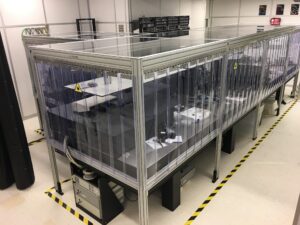 Amphos pump laser: 1030 nm, 1 mJ, 1 ps, 100 kHz, with optional pulse compression to 30 fs
Applications: pump–probe experiments, two-photon and multiphoton absorption spectroscopy, high repetition rate nonlinear optics, femtosecond micromachining, surface textuting, laser-induced breakdown spectroscopy- Yb:YAG multipass: 1030 nm, 60 mJ, 1 ps, 10 Hz
Applications: laser-induced breakdown spectroscopy, laser ablation, laser damage studies - Mid-infrared OPCPA: 3100 nm, 65 µJ, 40 fs, 100 kHz
Applications: Strong-field physics in the mid-IR, solid-state HHG, broadband absorption spectroscopy, resonant excitation, time-resolved vibrational spectroscopy - Additional equipment: suite of beam and ultrafast pulse diagnostics, beam imaging, infrared pyrometer, wavefront monitor, visible/near/mid-infrared spectrometers, second-order pulse autocorrelator, SHG FROG, among others
Laser systems at Voxel
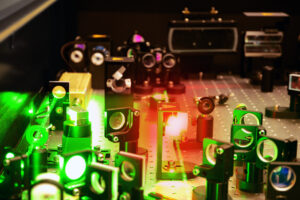 High harmonic beam line: 800 nm, 7.5 mJ, 30 fs, 1kHz
Additional equipment: viable gas injection, CCD 2048×2048 pixel XUV and x-ray detection, in vacuum XYZ motorisation, XUV spectrometer, XUV optics
Applications: HHG, attosecond pulse trains, x-ray generation, ultrafast transient absorption, ultrafast plasma diagnostics- High intensity beam line: 800 nm, 400 mJ, 45 fs, 10 Hz
Additional equipment: high intensity pulse delivery on gas or solid targets, beam focussing using OAP, pulse diagnostics, wavefront senting + deformable mirror pair, in vacuum motorisation and manipulation
Applications: laser wakefield acceleration, HHG and EUV/soft-X-ray pulses, ultrafast X-ray diffraction and imaging, ultrafast laser–plasma studies
For more details please visit: