
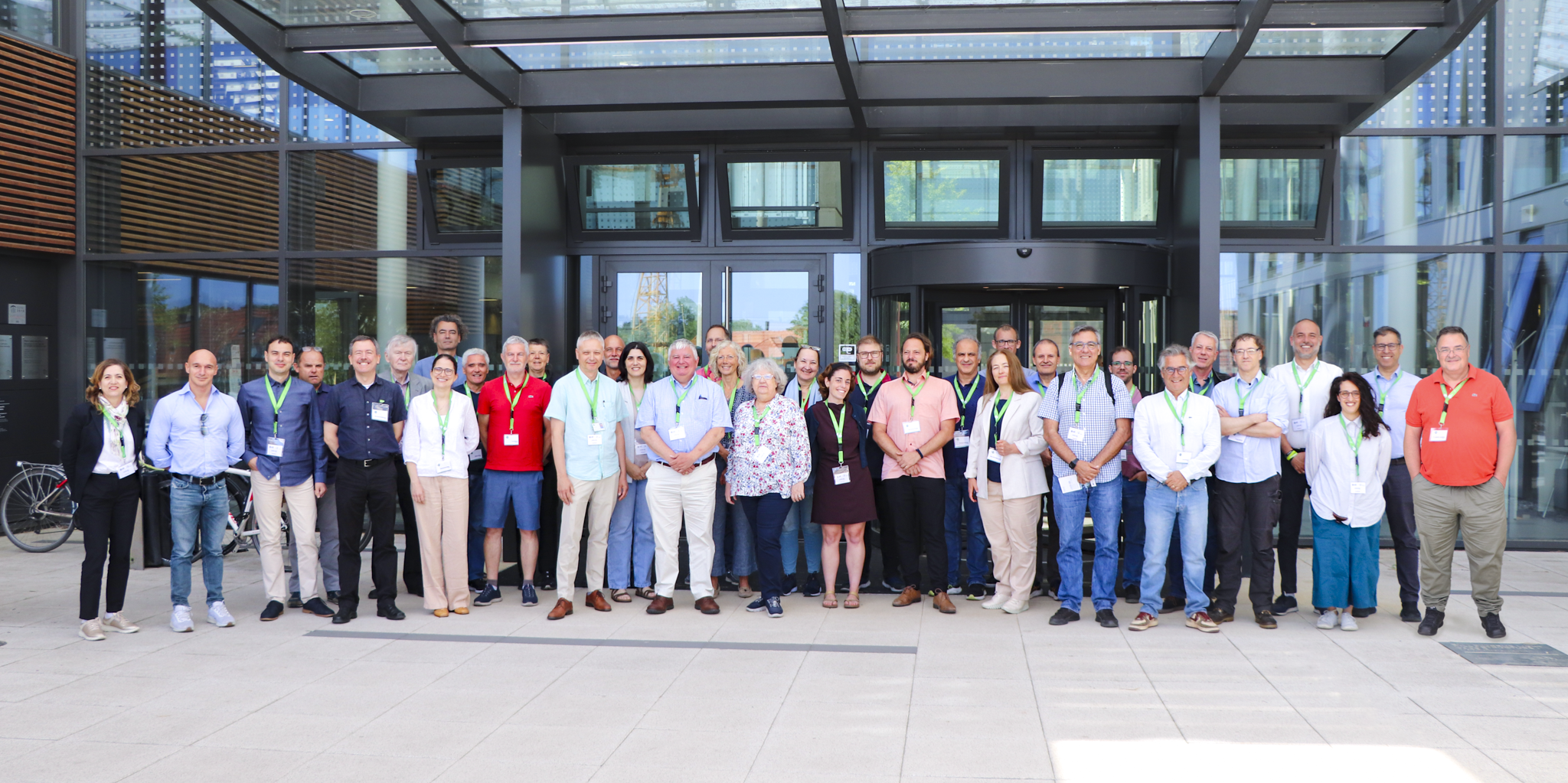
The Laserlab-Europe & Lasers4EU Annual & Users Meeting 2026, held from 26 to 29 May at the HiLASE Centre and ELI Beamlines, brought together leading researchers, industry experts, and early-stage scientists to explore the frontiers of laser-based technologies. This year’s hybrid event highlighted the transformative potential of lasers in space, cultural heritage, AI, and health, fostering collaboration across academia and industry. A standout success was the Lasers4EU poster session, which showcased cutting-edge scientific research from emerging talents.
During the General Assembly Meeting of the Laserlab-Europe AISBL, Luis Arnaut (Coimbra Laserlab) was elected as the new General Assembly (GA) Chair, with Fabrizio Consoli (ENEA-ABC) taking on the role of Vice Chair. We extend our warmest congratulations and wish them great success in their new positions.
John Collier, Executive Director of Laserlab-Europe AISBL, reflected on the event:
“This year’s Annual Meeting underscored the strength and vibrancy of our scientific community. The discussions and collaborations here will shape the future of laser science in Europe.”
The Lasers4EU poster session spotlighted research from across partner laboratories. The Freek Ariese Poster Prize recognized outstanding contributions from early-stage researchers, with winner Tomas Thor (HiLASE) showcasing his work on real-time detection of micrometer-scale dust contamination on optical surfaces. The user meeting fostered dynamic scientific exchange, ensuring the project continues to serve the user community at the forefront of laser-based science.
Sylvie Jacquemot, Scientific Coordinator of the Lasers4EU project, commenting on the Lasers4EU poster session and user meeting, noted:
“The Lasers4EU poster session was a remarkable display of scientific excellence, and the poster award recognized outstanding contributions from our early-stage researchers. The user meeting provided a valuable platform for scientific exchange, ensuring our work remains at the forefront of laser-based research.”
Thematic Session Highlights
The Role of Lasers in the Future of Space Development
This session explored how lasers are revolutionizing space missions, from debris tracking and optical communications to advanced manufacturing and planetary exploration. Jan Vanda (HiLASE Centre) introduced the session, while Séverine Boyer (CNRS/MINES-Paris/PSL) presented on laser ablation propulsion, and Vit Ledl (Toptec/IPP CAS) discussed space-proven optics. Torsten Vogel (SAB Aerospace) offered insights on satellite laser communication, and Andrea Di Mira (European Space Agency) spoke on orbital maintenance via laser momentum transfer. A panel discussion capped off the session, delving into the future of laser applications in space.
Unlocking Stories from the Past: Laser-based Technology for Cultural Heritage
Sara Mosca (Central Laser Facility) introduced this session, which showcased how laser and spectroscopy techniques are transforming cultural heritage preservation. Sam Walker (Agilent Technology) demonstrated non-destructive analysis using SORS, while Marta Ghirardello (NIREOS) presented a novel Fourier transform-based technology for hyperspectral imaging. Antonina Chaban (CNR) shared new research directions in wall painting diagnostics, and Victor Gonzalez (ENS Paris Saclay) connected heritage science with photochemistry through luminescence studies. A tutorial session invited participants to collaboratively design laser-based experiments for cultural heritage.
AI for Laser-based Systems
Thomas W. Bocklitz (IPHT Jena) welcomed attendees to this session, which focused on the intersection of AI and laser-based systems. Kosmas Kepesidis (LMU Munich & Center for Molecular Fingerprinting) discussed modeling human health with laser-based molecular profiles, while Pegah Dehbozorgi (FSU, IPHT Jena) explored AI for laser-based imaging technologies. Rob Shalloo (DESY) presented on digital twins for high-power laser systems, and Davorin Peceli (ELI Beamlines) highlighted smart control and diagnostics for laser-plasma research.
New High-Intensity Laser Applications in Health
Riccardo Cicchi (LENS) and Pavel Blaha (ELIMED) co-chaired this session, which focused on biomedical applications of high-intensity lasers. Gabriele Grittani (ELI Beamlines) discussed laser-acceleration of electrons, while Josefine Metzkes-Ng (HZDR) presented on laser-driven proton beams for biomedical research. Marco Borghesi (Queen’s University Belfast) explored laser-driven carbon ion beams for radiobiology, Gabriele Bandini (Aukelos) addressed the translation of VHEE laser-plasma acceleration into radiotherapy, and Antoine Maitrallain (IMT Atlantique) spoke on laser plasma acceleration for radionuclide production.