
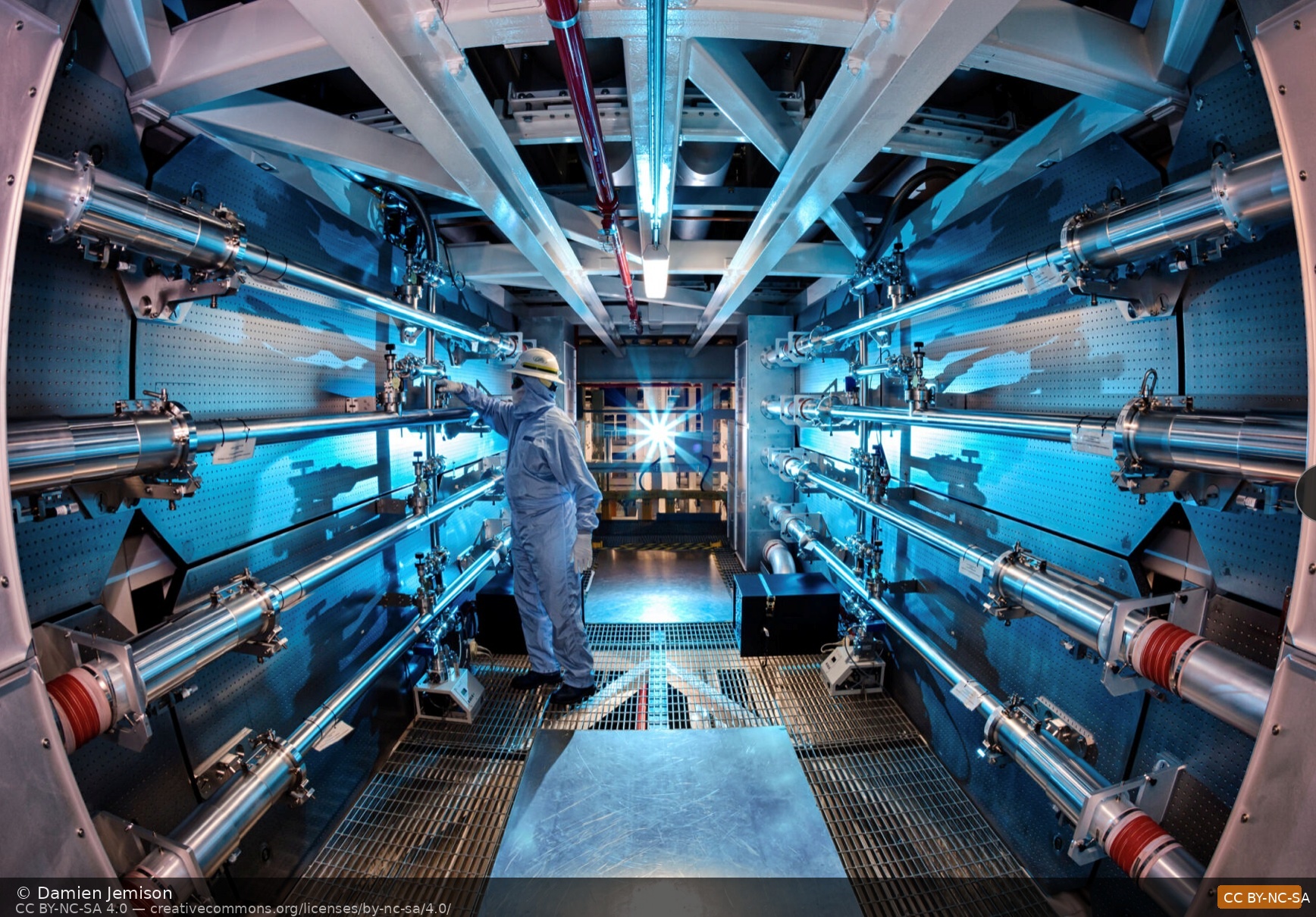
The National Ignition Facility (NIF) stands as the world’s largest high-energy, high-power laser system. Since August 2021, using the indirect drive of DT capsules by hohlraum X-rays, it has achieved groundbreaking milestones in inertial confinement fusion (ICF), producing fusion energy output that, to date, exceeds the laser energy delivered to the target by more than a factor of four.
The “Advanced Radiographic Capability” (ARC) laser at NIF is a short-pulse laser designed to generate X-ray flashes with energies of up to 1 MeV in order to image the DT capsule precisely at the moment of its implosion. However, due to limitations in the ARC’s long-focal-length optics, 80% to 99% of the laser energy remained below the relativistic intensity threshold, necessitating a technical solution.
Since 2020, cone-shaped targets, known as Compound Parabolic Concentrators (CPCs), have been employed at the ARC to significantly boost local laser intensities and enable the generation of electrons and bremsstrahlung in the multi-MeV range.
Over the past seven years, a collaboration between the plasma physics groups at Frankfurt University, GSI Darmstadt, FSU Jena and the inertial fusion group at ENEA Frascati, has pioneered a novel approach to generating ultra-intense laser-driven secondary sources of particles and radiation using low-density foams and their application in multi-disciplinary research. These findings have been documented in high-impact journals also within the Nature Portfolio, including Nature Communications (2022), 13, 170 and Scientific Reports (2024)14(1):14785; (2026) 16:71649.”
Leveraging the expertise in foam-target interactions developed at the PHELIX and ABC laser facilities, we proposed the NIF Discovery Science project: ‘Ultra-bright MeV photon sources driven by direct laser accelerated (DLA) electrons on ARC‘, led by Principal Investigators Dr. Fabrizio Consoli (ENEA, Nuclear Department, Frascati Research Center) and Professor Olga Rosmej (Goethe University Frankfurt am Main and GSI Helmholtzzentrum für Schwerionenforschung GmbH, Germany). The project hypothesized a tenfold increase in the flux of laser-generated relativistic particles and secondary radiation compared to the benchmarks established with CPCs. By shifting focus from the CPC—which relies on geometric laser energy concentration—to volumetric laser interaction via Direct Laser Acceleration (DLA) using foams, this approach aimed to redefine the limits of radiographic brightness available at the ARC facility.
The campaign was executed in February 2026, supported by a dedicated team of NIF scientists. Preliminary analysis of the experimental data confirms the campaign’s success, demonstrating an up to 10-fold increase in relativistic electron flux and MeV Bremsstrahlung in the region of giant dipole resonance per Joule laser energy than previously reported CPC benchmarks. This achievement represents a significant milestone in the development of laser-driven particle and radiation sources, with profound implications for inertial confinement fusion (ICF) diagnostics at the NIF and high-energy-density physics facilities worldwide.
Notably, the results obtained at the high energy, short-pulse PHELIX facility at GSI Darmstadt, scale effectively with the tenfold higher energy available at ARC. At the same time, the interaction of the nanosecond laser pulse with the low-density polymer foams was investigated in detail at the ABC high-energy nanosecond laser facility at ENEA Frascati; the insights gained from this study served to characterize the properties of the NIF nanosecond beam, which converted the foam into plasma prior to the arrival of the ARC pulse. This robust scaling underscores the critical role of the PHELIX and ABC lasers as high-precision platforms for developing and validating ICF-relevant experiments.
This multi-disciplinary and successful collaboration activity is strictly related to both the two Laserlab-Europe AISBL Expert Groups
- “Micro- and nano-structured materials for experiments with high-power lasers” https://laserlab-europe.eu/expert-groups/micro-and-nano-structured-materials-for-experiments-with-high-power-lasers/
- “Laser-driven Inertial Confinement Fusion (ICF) – Inertial Fusion Energy (IFE)” https://laserlab-europe.eu/expert-groups/laser-driven-icf-ife/