
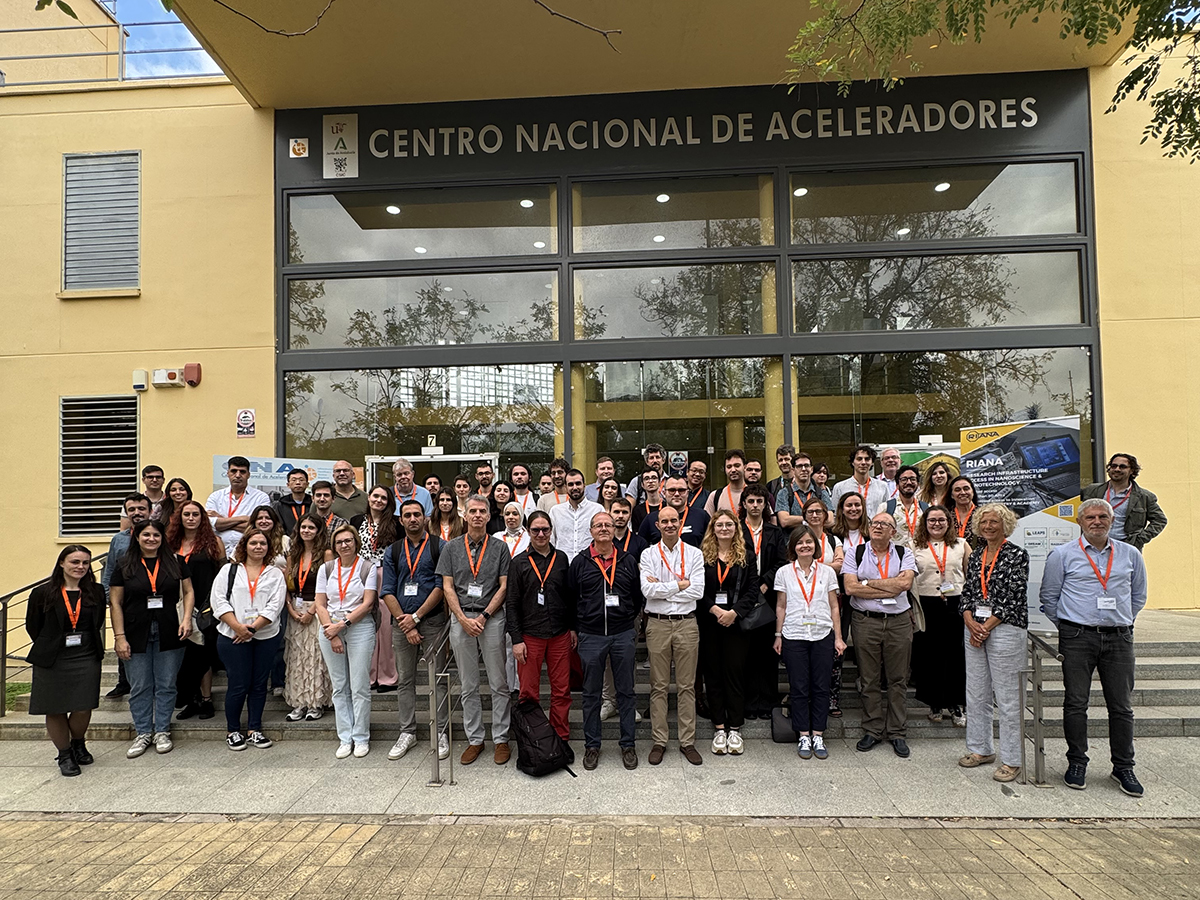
The RADIATE and Laserlab-Europe User Meeting in Nanoscience was a great success, bringing together more than 65 researchers from different European institutions.
The meeting, organized jointly by the Center for Microanalysis of Materials (CMAM-UAM) and the National Center for Accelerators (CNA), served as a meeting point for the scientific community working with the European research infrastructures Laserlab-Europe and RADIATE, as well as for users of the distributed ICTS named IABA (Infrastructure for Accelerator-Based Applications).
The event was opened by José María López Gutiérrez, director of the CNA, and Gastón García López, director of CMAM-UAM, who highlighted the importance of scientific collaboration and the role of large infrastructures in the advancement of nanotechnology and materials science.
 During the conference, the latest results obtained by users of both networks were presented, future lines of cooperation were discussed, and new applications of accelerator- and laser-based techniques in the field of nanoscience were explored. Both networks, as well as the IABA distributed ICTS, were also presented. A space was also dedicated to the presentation of the RIANA project, an European project in which more than fifty major European infrastructures, including CNA and CMAM-UAM, collaborate with users in the field of Nanoscience and Nanotechnology. The project’s objectives and the opportunities it will offer to strengthen collaboration between European infrastructures, and some of the possibilities for users were highlighted.
 Lasers4EU participated in the joint User Meeting with numerous user presentations highlighting laser-based science in this field. Lasers4EU users presented their research to the laser and ion beam communities and exchanged ideas on how to combine different techniques e.g. in the RIANA project.
The meeting consolidated the close collaboration between the European infrastructures and reinforced the shared commitment to promoting scientific excellence and innovation in the field of advanced research using ion beams and laser-based science.